
Twenty-nine Years
On the Time Between a Wedding and an Obituary.

One of the things I miss most about living in Porto was the seeming absence of death.
It was there—I knew it was—but I never felt its presence as intensely as I did in the countryside.
I walked past Agramonte Cemetery countless times, almost to reassure myself that people were buried there too. Some remained sealed inside lead-lined tombs, behind coloured stained-glass windows through which all that could still be seen was a white cloth draped over a coffin.
In the eight years I lived in Porto, I crossed paths with a funeral in that cemetery only once.
Everything about it was different.
The women were impeccably dressed in satin black, wearing striking high heels and wide-brimmed hats that concealed their faces. There were no black wool shawls smelling of mothballs, no people with greasy spectacles, black trousers that looked like pyjamas, or the clumsy slip-on shoes that elderly women in the villages seem to cherish—as though they were an essential part of the identity they all wished to belong to.
Even the men at that city funeral were elegant, in sharply pressed trousers, polished shoes, and crisply ironed shirts.
Back in the village, the women might have looked awkward, their faces weathered and their eyes heavy with sorrow, but the men were always worse. Yet here I saw no pot-bellied men lingering outside the cemetery gates, arms folded, legs spread wide, chatting amongst themselves as though nothing of consequence were happening.
No one broke down.
No one cried out.
No one wailed.
It suddenly occurred to me that the professional mourners of old had belonged only to the rural world—as though they had come not merely from another time, but from another country altogether.
Until then, I had assumed funerals were much the same everywhere in Portugal, that when someone we love dies there is simply too much turmoil for silence to exist.
But not there.
In the heart of Porto, emotions were restrained, and silent tears fell onto silk dresses.
“We villagers shout,” a history professor once declared bluntly to a lecture hall full of students. “We’re violent.”
Unaware that I had come from the Beiras, he paced slowly along the aisle while I watched him in silence.
“The people from the Beiras are violent. Have any of you ever witnessed a pig slaughter? They stab the animal in the neck and simply stand there, watching it slowly bleed out. Parents even call their children over to catch the blood, stirring it in a basin.”
The entire scene was painfully familiar to me.
Yet I sat there speechless.
The professor was not entirely wrong.
We have never been people of refined gestures, whether we are mourning the dead or bringing new life into the world.
In the city, however, animal sounds are something to be ashamed of.
You will never hear the agonised squeal of a rabbit echoing through its streets as a knife is driven into its throat, nor catch the metallic smell of warm blood bursting out in sudden streams, splashing the hands of the killer and those helping him.
You hear none of it.
Not the cries of a woman.
Not the laughter of a child.
Not even church bells announcing a death.
On that warm autumn afternoon in Agramonte, someone was burying someone else while the city carried on around them. Cars drifted along the narrow road leading to a larger avenue beside a shopping centre.
The funeral seemed like nothing more than a small, unnoticed detail woven into the fabric of the city.
In all the years I lived in Porto, it was the only death that ever crossed my path.
Death in the village is loud.
It begins in cafés, on park benches beside old fountains, in every place where people gather to talk.
The questions are always the same.
“Who has died this time?”
“What was wrong with them?”
Was it an illness?
Which illness?
Or worse—did they take their own life?
And if they did, how?
Rat poison?
A rope?
Were they found hanging from the tree in their garden, or lying in the pigsty, foam gathering at the corners of their mouth?
The gossip spreads like ink across white cloth, always flowing from the same sources: the funeral notices pinned to café doors, the ones taped to bakery windows and florists’ shopfronts, and, more recently, the digital obituaries shared on Facebook by funeral homes announcing the latest death.
Everything happens so quickly that, sometimes, there is hardly time to learn who has died.
The faces of the dead linger for days, gradually joined by notices for seventh-day memorial Masses, or invitations to commemorate the anniversary of someone’s death.
You cannot walk through the village without their bright eyes continuing to haunt you.
Their photographs remain on display for days, accompanied by the details of an entire life: their name, surname, and the web of family ties connecting them to everyone else.
More often than not, it takes someone’s death for us to discover their real name.
His name may be José Correia, but to everyone he is simply Uncle Zé da Vina.
That is why, when a death is announced, a name alone often means very little.
The same thing happened to me one sad afternoon in the spring of 2026.
I had already written the day off. I was lying on the sofa, half-heartedly searching for something mindless to watch before drifting off to sleep, when the sharp buzz of my phone jolted me awake.
It was a message from my mother.
No words.
Just the image of a dead man, shared from one of those funeral pages online.
Beneath the photograph were the usual details, listing his place within the family before saying anything about the man himself:
“Son of...”
“Brother of...”
“Grandson of...”
Grandson?
I paused.
Then he had to be young.
My eyes heavy with tiredness, I looked more closely at the photograph.
He was a handsome young man, dark-haired, with bright black eyes.
I had never seen him before.
To make matters worse, the digital obituary had been badly cropped, leaving the names of his parents barely visible. Someone had taken a careless screenshot, and the missing details disappeared beneath intrusive advertisements scattered across the webpage.
“For heaven’s sake... She’s always sending me pictures of dead people without even telling me who they are,” I thought, irritated.
“Who is it?” I asked, bluntly and without much patience.
I didn’t even think to look at the young man’s surname first.
With so many ghosts wandering through our villages, I assumed he was simply another one of them.
In all the confusion, I never even looked at his parents’ names.
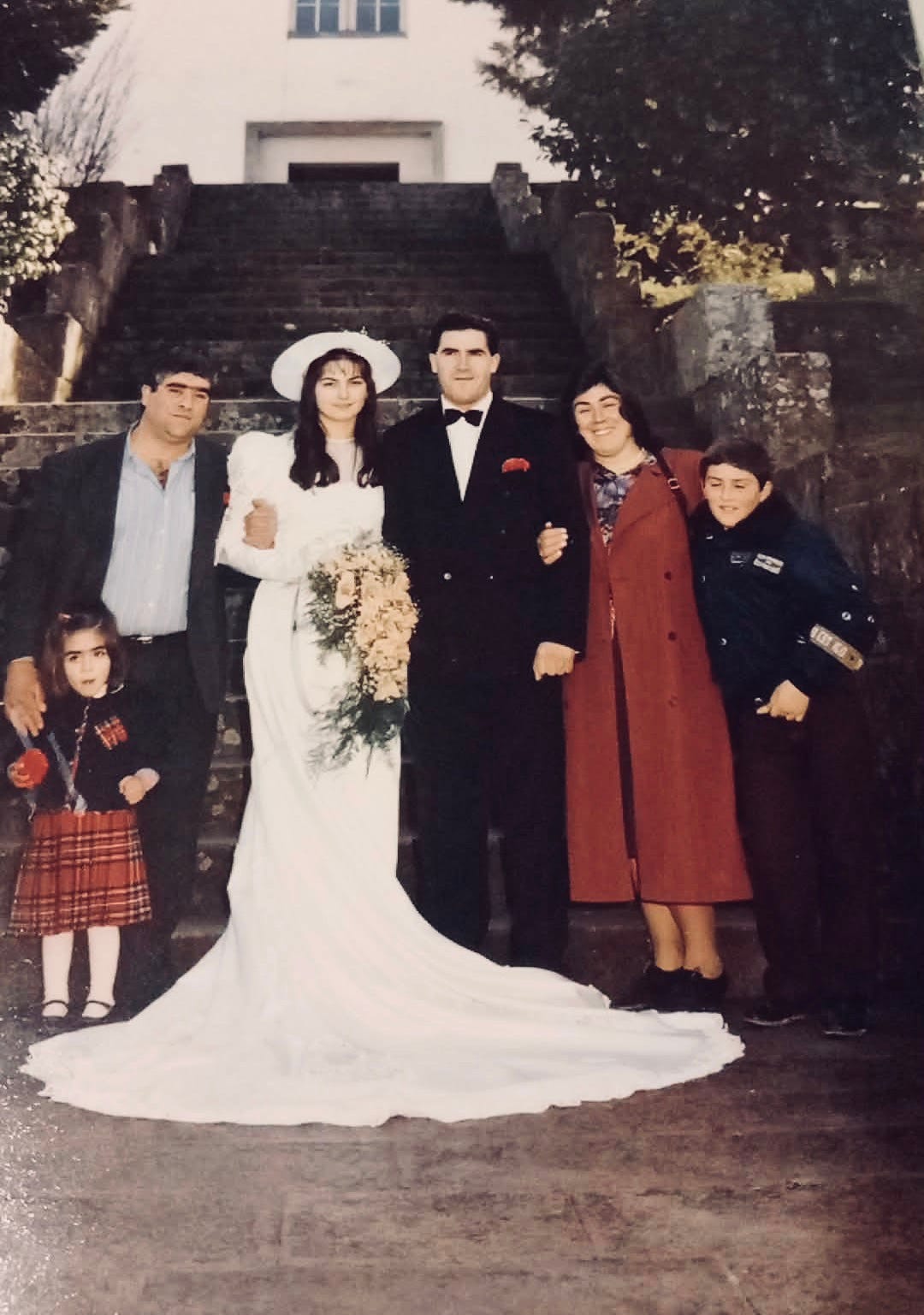
It was a wedding day, sometime around 1994.
In the photograph, there are six of us. I look about four years old.
I’m wearing a red-and-black tartan pleated skirt, a black knitted cardigan fastened with matching buttons, my hair tied into an awkward little topknot, and white tights tucked into shiny black patent shoes that made me slip with every step.
It must have been winter, or perhaps the tail end of a bitter autumn.
Behind us, a pale mist hovered above the church, almost swallowing the cross at its summit.
Despite the weather, it was a day of celebration.
We posed for the photograph at the foot of a long flight of granite steps, as dark as the sky itself. They seemed older than time—worn, weathered, and flanked by towering camellia trees whose branches bent over the path leading up the hill to the church.
It is a curious photograph.
No one is really paying attention.
My brother has his eyes tightly shut, nestled against my mother.
She looks plump in a dusty-rose trench coat that makes her appear older than she really was.
I am clinging to my father, my attention drifting elsewhere, captivated—perhaps—by the bride.
Because she was nothing short of a princess.
Her brilliant white dress spread around her in a wide circle, covering part of the grey ground beneath her. It looked like a cloak of joy, hiding every trace of the dark clouds above.
The dress hugged her slender figure, accentuating the softness of her curves. Her straight-brimmed white hat did nothing to diminish the beauty of her chestnut hair, beneath which a shy smile quietly emerged.
Until that day, I had never seen a woman so beautiful.
She looked as though she had stepped straight out of an American romantic film.
I was so mesmerised by her beauty that it took me a moment to realise she was my cousin.
It must have been a happy day, just as the old saying promises: “A rainy wedding is a blessed wedding.” Surely such a day could only lead to a lifetime of happiness and good fortune.
A few months after the wedding, fate gave them their first child.
In life’s arithmetic, what is given is given forever.
Or so we like to believe.
A few years later, as the little boy grew into a lively young child, Tita became pregnant again.
But two pregnancies had changed her forever.
She was no longer the princess from the photograph.
She had become an ordinary woman.
I saw her again one unexpected afternoon.
Everything about her belonged to a different woman.
She wore denim overalls, oversized trainers, and a faded blouse bleached by the sun.
But what stood out above everything else was her enormous belly, ready to bring another child into the world.
Time had worked its quiet changes on all of us.
By then, I was no longer the little girl in white tights and patent leather shoes.
That earlier child had begun to feel like someone separate from me, as though she had lived an entire lifetime in those ten years and I had been reborn into a different body at fourteen.
Tita, on the other hand, had traded beauty for joy.
She looked happy, radiant, with two welcoming arms that always seemed ready to embrace whoever stood before her.
“Look how you’ve grown, Joanita.”
It took me a while to connect the woman standing before me with the bride in the photograph.
But Tita, measuring time by the slower rhythm of adulthood, hurried to embrace me as though I were still the little girl she had seen on her wedding day.
The embrace felt strangely familiar.
And yet bittersweet.
We were family, but she was almost a stranger—someone who appeared only occasionally, like a figure returning every few pages in a family photo album.
That was true of almost everyone on my father’s side of the family.
Our lives were made up of constant absences interrupted by brief reunions.
We saw one another at weddings, baptisms, and funerals.
Only rarely would we happen to stop by Uncle Police Officer’s house on the outskirts of Viseu.
That was where we would occasionally run into my cousins.
Zé Manel—a mirror image of his father, tall, handsome, and endlessly good-natured.
And “the other one”—whose name has escaped me forever, remembered only as the cousin who, convinced his good looks would carry him through life, ended up marrying an old woman for her money.
And, of course, Fátima, mother to a lively little boy and another baby who was still on the way.
“She’s due any day now.”
“Yes, she is.”
“How have you all been?”
“You’ve grown so much, Joana.”
There was never much more to say than that.
The conversations of people who have not seen each other for years always circled around the same emptiness. In the absence of eloquent words, embraces and exchanged glances were enough, keeping any deeper affection or genuine joy carefully contained.
Yet I wanted to say more.
“I used to call you Tita when I was little, didn’t I?”
And she would probably have smiled and replied,
“Yes, you did. I even looked after you a few times.”
It might have been a lovely conversation.
But adolescence has a way of silencing you. My lack of confidence always got the better of me, and, like everyone else, I settled for those half-smiles.
There is, however, something greater than blood itself.
Tita, my father’s first cousin, made me want to move closer to her and pull away at exactly the same time.
I was drawn to her because she was family, and afraid of her for precisely the same reason.
People were always whispering about that side of the family. They were said to believe in strange things—fortune tellers, folk magic, miraculous potions.
What if they were all mad?
What if I was like them?
What if, at the slightest problem, I too would one day seek out a witch instead of a doctor?
What if I carried that same blood?
What would that say about me?
Who were these people, really, branches of the same family tree, split apart by a trunk cracked clean down the middle?
All of this ran through my mind as I watched Tita.
She was no longer the slender bride in the brilliant white dress with chestnut hair.
All of that had given way to an enormous pregnant belly.
I wanted to feel the excitement the adults seemed to share, their eager curiosity to touch her stomach, to ask endless questions about the baby, the tiny clothes, the little shoes, the blankets.
Instead, all I felt was the instinctive revulsion of a teenager watching something grow inside a woman’s body that would eventually have to force its way out.
To me, it looked as though she herself might burst apart and disappear forever.
What if pregnancy killed her?
What if it sent her to a cemetery?
Everyone spoke of pregnancy as something miraculous, of the mysterious glow that surrounds a woman during those nine months.
I could see only a void pulling her inward.
As though she were slowly disappearing into the child she carried.
As though she were giving birth not to another human being, but to a younger, happier, more beautiful version of herself, leaving behind nothing more than an empty shell drained of its vitality.
The mother was being born.
The woman was fading away.
And because Tita was expecting a daughter, that thought seemed even more convincing to me.
My mother took a while to reply.
So I looked back at the screen.
For the first time, I noticed the young man’s surname.
Almeida.
My surname too.
Then I read his mother’s name.
Fátima Almeida...
I stared at the photograph, unable to look away.
“Is he Tita’s son?” I asked.
My mother answered with a single word.
“Yes.”
I looked at the photograph again.
I had had twenty-nine years to get to know him, yet all that remained in my memory was the shadow of a little boy running circles around his mother’s overalls, bright-eyed and full of life, excited that he was about to have a baby sister.
Twenty-nine years.
Everything that had happened between that little boy and the photograph in the obituary had vanished from my life.
After that single yes, I called my parents immediately.
It took only a few words to tell them I would go to the wake with them.
I dressed in a hurry and left the house.
They were already waiting for me, carrying a bouquet of white flowers with a sympathy ribbon for the family.
The journey felt endless.
Only that day did I discover that Fátima lived somewhere in the mountains of Penalva do Castelo, far from her parents—and even farther from us.
The drive took more than an hour. We took a few wrong turns that led us down unfamiliar roads before some locals pointed us back in the right direction.
The moment they noticed the flowers in our hands, they immediately knew why we were there.
When we arrived, I parked on a dirt track and we walked towards an old chapel perched on top of a hill.
People stood outside.
Silence hung over the place.
No one was crying.
Everyone seemed swallowed by the same vacant, distant gaze.
Beside the coffin stood a woman in denim jeans, a loose blue shirt, and heavy hair falling across her face.
I did not recognise Tita at first.
She stood perfectly still, staring at the coffin without the slightest trace of expression.
And that was the first—and the last—time I ever met my cousin.
Tita came towards us and embraced me once again, the way someone embraces a stranger simply because they are grateful they came.
Then she told us the whole story.
Her son had had a baby.
A few months later, the baby died of brain cancer.
“After that,” she said quietly, “my own son was never the same again. And he died of the very same disease.”
Tita’s husband was still a relatively young man, yet he spoke as though life had already ended.
He told us how their son had been abandoned by his girlfriend as soon as she learned he was ill.
Then he asked a question that seemed to have no answer.
“What’s the point of living when everyone you’ve ever loved dies?”
“First my parents. Then my father-in-law. Then my grandson. And now my son.”
“What will Christmas be now? Or any celebration at all?”
“It will just be Fátima and me.”
I thought again of the photograph.
That beautiful young couple, still alone, smiling at the future.
Now they stood before me once more.
Alone again.
Completely transformed.
There was nothing I could possibly have said that would have mattered.
Funerals in the villages are usually loud.
But this one was different.
Here, it was the silence of grief that echoed across the mountains.
Even though no one spoke, I had the strange feeling that, when the church bells began to ring for the burial, the entire mountain range gathered Tita into its arms, rocked her gently, and wept with her.
Pregnancy did not send Tita to a cemetery.
It did not kill her body.
But years later, it led her there all the same.
Hi. If you enjoyed what you read and think my work deserves support, consider “buying me a coffee” by clicking on the image below:

Thank you so much.
“More often than not, it takes someone’s death for us to discover their real name.”
And their real history.
Welcome back, Joana! 🌱
Heartbreaking. Brilliantly written.
I am reminded of my father, late in life, saying “All my friends are in cemeteries.”